I volumi storici di Metron
Dove si consultano oggi
I volumi di Metron sono su Springer, non su questo sito.
Archivio digitale: link.springer.com/journal/40300/volumes-and-issues
L’archivio digitalizzato su SpringerLink parte dal volume 68 (2010).Per i volumi precedenti — cioè per i primi novant’anni della rivista — il canale è la consultazione in biblioteca o il prestito interbibliotecario. In Italia si cerca su OPAC SBN. ISSN 0026-1424.
Se siete arrivati qui da un link a /volumi/... o /ultimo/..., quello era il vecchio archivio online della rivista, costruito su un database che non esiste più. L’abstract che cercavate non è su questa pagina: qui trovate la strada per arrivarci.
Come era organizzato l’archivio
I volumi sono numerati in cifre romane: vol. I nel 1920, vol. LXVII nel 2009, vol. LXVIII nel 2010 (archivio RePEc depositato dal dipartimento di statistica della Sapienza). Ogni volume raccoglie più fascicoli, spesso pubblicati come numeri doppi o quadrupli — è il motivo per cui i riferimenti bibliografici hanno forme come Metron III(3–4) o IX(3–4).
⚠️ Attenzione a un equivoco che abbiamo commesso anche noi. SpringerLink mostra i volumi in cifre arabe (vol. 68, vol. 70…), e viene naturale concluderne che la rivista abbia cambiato numerazione intorno al 2010. Non è così: è una resa della piattaforma. Le citazioni ufficiali della rivista restano in cifre romane ben oltre — l’editoriale del centenario cita Metron LXIX (2011) e LXXIV (2016). Quando citate un volume, la forma romana è sempre corretta.
Fino al primo mandato di Giovanni Maria Giorgi (2003–2006) la rivista era plurilingue: italiano, inglese, francese e tedesco convivevano nello stesso fascicolo, per scelta esplicita di Gini. Da allora la pubblicazione è solo in inglese.
Alcuni volumi che vale la pena conoscere
Volume I, fascicolo 4 — 1921
R. A. Fisher, On the “probable error” of a coefficient of correlation deduced from a small sample, pp. 3–32.
È il lavoro in cui Fisher introduce la trasformazione che oggi si chiama z di Fisher: il modo di rendere approssimativamente normale la distribuzione del coefficiente di correlazione, e quindi di poterci costruire sopra intervalli di confidenza. Un anno dopo la fondazione, la rivista ospitava uno dei contributi fondativi della statistica inferenziale.
Volume II, fascicolo 3 — 1923
A. Tschuprow, pp. 461–493.
Contiene l’idea dell’allocazione ottimale nel campionamento stratificato — come ripartire un campione tra gli strati per minimizzare la varianza. Il risultato è oggi comunemente attribuito a Neyman (1934): Tschuprow l’aveva anticipato di undici anni, su queste pagine.
Volume III, fascicoli 3–4 — 1924
R. A. Fisher, The distribution of the partial correlation coefficient, pp. 329–333.
La distribuzione esatta del coefficiente di correlazione parziale. È il riferimento che ancora oggi compare nelle voci enciclopediche su partial correlation e partial autocorrelation.
(Nota: Springer indica pp. 329–333, Google Scholar 329–332. Non abbiamo verificato l’originale a stampa.)
Volume IX, fascicoli 3–4 — 1932
Un fascicolo con due nomi:
– S. S. Wilks, pp. 87–126 — i risultati della sua tesi di dottorato
– B. de Finetti, pp. 127–138
La Biblioteca di Metron
Negli anni Sessanta la rivista affiancò una collana di volumi, dedicata a diffondere i fondamenti della statistica e del calcolo delle probabilità.
Il titolo più noto è il lavoro congiunto di Bruno de Finetti e Leonard J. Savage:
De Finetti B., Savage L. J., Sul modo di scegliere le probabilità iniziali, Biblioteca del “Metron”, serie C: Note e Commenti, Roma, Istituto di Statistica dell’Università, 1962, pp. 82–154.
De Finetti ne riprese e tradusse il contenuto in Probability, Induction and Statistics (The Art of Guessing), Wiley, New York, 1973. Savage, oltre che autore, sedeva nel comitato editoriale di Metron.
Una precisazione necessaria
Questo sito non possiede e non distribuisce i volumi di Metron. Non ne detiene i diritti e non è l’editore.
Le citazioni bibliografiche riportate qui provengono dall’editoriale del centenario pubblicato dalla rivista stessa nel 2020, e sono verificabili lì. Servono a una cosa sola: permettere a chi cerca un riferimento di trovarlo, in biblioteca o su Springer.
Nell’archivio
- Archivio Metron — la storia della rivista dal 1920
- Corrado Gini — il fondatore
Fonti
| Fonte | Ente | URL | Tipo |
|---|---|---|---|
| Volumi e fascicoli di Metron | Springer | https://link.springer.com/journal/40300/volumes-and-issues | editore |
| Alfó M., Metron: one hundred years of statistics, Metron 78 (2020) | Springer / Sapienza | https://link.springer.com/article/10.1007/s40300-020-00166-6 | editoriale del centenario |
| R. A. Fisher Digital Archive | University of Adelaide | https://digital.library.adelaide.edu.au/dspace/handle/2440/15169 | archivio d’autore |
| Catalogo del Servizio Bibliotecario Nazionale | ICCU | https://opac.sbn.it/ | catalogo bibliotecario |
Domande frequenti
Dove si trovano oggi i volumi di Metron?
Su Springer, all’indirizzo link.springer.com/journal/40300. L’archivio digitale parte dal volume 68 (2010); per i volumi precedenti serve la consultazione in biblioteca o il prestito interbibliotecario.
Perché i vecchi link a metronjournal.it/volumi/ non funzionano più?
Il vecchio archivio online era costruito su un database che non è più in funzione. Le URL storiche sono state redirette a questa pagina.
Fisher ha pubblicato su Metron?
Sì, almeno due lavori negli anni Venti: On the “probable error” of a coefficient of correlation deduced from a small sample (1921) e The distribution of the partial correlation coefficient (1924).
Posso scaricare da qui i PDF dei vecchi numeri?
No. Questo sito non detiene i diritti sui contenuti della rivista e non li distribuisce.
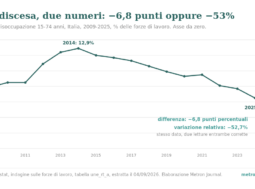
Percentuali e punti percentuali: l’errore più comune di chi scrive di numeri